
During the first year of life, babies learn about the world long before they can speak or move independently. Every day brings new discoveries as they begin to observe, listen, touch and interact with the people and objects around them.
Exploration during this stage is gentle and gradual. Small moments such as watching a face, reaching for a toy or listening to a familiar voice all help babies begin to understand how their world works.
These early experiences form the foundation for learning, movement and communication later on.

Temperament Is Inborn
Research suggests that temperament has a biological basis. Babies are born with different thresholds for stimulation, different emotional reactivity and different energy levels. This means that two babies raised in similar environments may still behave very differently simply because of who they are.
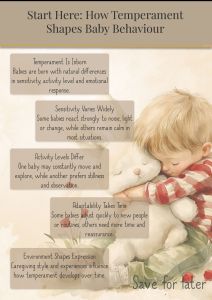
Sensitivity to Stimulation
Some babies are highly sensitive to sensory input such as bright lights, loud sounds or busy environments. They may become overwhelmed more easily and need calmer settings to feel comfortable. Other babies tolerate stimulation well and remain relaxed even in noisy or unfamiliar situations. Neither pattern is better or worse. They simply reflect different nervous system responses.
Activity Levels Vary
Activity level is another key aspect of temperament. A highly active baby may kick constantly, roll early and seem eager to move. A lower-activity baby may prefer watching quietly, observing surroundings and conserving energy. Both patterns can be completely normal.

Adaptability to Change
Some babies adjust quickly to new people, places or routines. Others need time to warm up and may become distressed when faced with unfamiliar situations. Babies who need more time are not being difficult. They simply process change more slowly and benefit from gradual transitions.
Environment Shapes Expression
While temperament is inborn, experience influences how it develops. Responsive caregiving helps babies feel safe regardless of their natural style. Over time, babies learn strategies for coping with stimulation, frustration and change. A sensitive baby supported gently may grow into a thoughtful, observant child. An energetic baby guided appropriately may develop confidence and resilience.
There Is No “Good” or “Bad” Temperament
Parents sometimes worry that their baby is too demanding, too sensitive or too intense. In reality, these traits are part of normal human variation. Understanding temperament can reduce self-doubt and help you respond in ways that suit your baby’s needs.
Learning Your Baby’s Unique Style
The more you observe your baby, the easier it becomes to anticipate what helps them feel secure. You may notice patterns such as needing quiet before sleep, preferring gradual introductions to new people or thriving on active play. Responding to these cues strengthens trust and connection.
Personality Is Already Beginning
Temperament is not the same as personality, but it forms the foundation for it. Your baby’s preferences, reactions and ways of engaging with the world are early glimpses of the person they will become.