
There’s a moment, usually sometime in the first few weeks, when your baby looks directly at you and it feels like the whole world stops. It’s not your imagination. That eye contact is doing something important, for your baby and for you. It’s one of the earliest and most powerful forms of communication your baby has, and it’s worth paying attention to.

It Builds the Bond
From the very beginning, eye contact is how your baby starts to know you. It signals safety, familiarity, and love without a single word being needed. Every time you hold your baby’s gaze, you’re reinforcing that they are seen and that they matter. That feeling of being known is the foundation of secure attachment, and it starts here, in these quiet face-to-face moments.
It doesn’t take long, and it doesn’t need to be perfect. Just present.
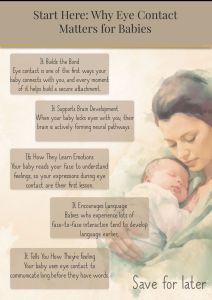
It Supports Brain Development
Eye contact isn’t just sweet, it’s neurological. When your baby locks eyes with you, their brain is actively working, forming the neural connections that will later support communication, empathy, and social understanding. Research shows that when a baby and caregiver share eye contact, their brainwaves actually synchronise. Your baby’s brain is shaped, in part, by these moments of connection with you.
The early months matter more than most people realise.
It’s How They Learn Emotions
Long before your baby understands words, they are reading your face. Your expressions during eye contact are their first introduction to what emotions look like. When you smile, look surprised, or show concern, your baby is taking notes. This is the beginning of emotional literacy, and it happens naturally through the everyday moments you share together.
You are quite literally teaching your baby how feelings work.

It Encourages Language
Babies who have lots of face-to-face time with their caregivers tend to develop language earlier. Eye contact creates a natural back-and-forth, you talk, they respond with sounds or expressions, you respond to that, and so on. That rhythm is the earliest form of conversation, and it lays the groundwork for words to follow.
Chat to your baby as much as you can, even when it feels a bit one-sided.
It Tells You How They’re Feeling
Your baby can’t tell you when they’re overwhelmed, tired, or ready to engage again, but their eyes will. When your baby breaks eye contact, it usually means they need a little breather. When they seek it out again, they’re letting you know they’re ready for more. Learning to follow these cues is one of the most useful things you can do in the early months, and it becomes instinctive surprisingly quickly.
Trust what you’re seeing. Your baby is already talking to you.