
The first year is packed with development, and it can be easy to feel like you should be tracking everything and comparing against a timeline. But milestones are guideposts, not deadlines. Every baby moves at their own pace, and the range of what’s typical is much wider than most people realise.
Here are five of the milestones that often happen in the first year, along with a little of what’s going on behind each one.

Smiles and Eye Contact (Around 6-8 Weeks)
The very first smiles — the ones that aren’t wind — usually appear somewhere around six to eight weeks. They tend to come in response to a familiar face or voice, and they’re more significant than they might look. This is baby beginning to connect emotionally with the people around them. It’s one of the earliest social milestones, and for most parents it’s the moment things start to feel genuinely interactive.
Eye contact deepens around the same time. Baby is starting to recognise you and track your face, and that back-and-forth of looking and responding is the very beginning of communication.
Rolling Over (Around 4-6 Months)
All those tummy time sessions are building towards this. Rolling from front to back usually comes first, followed by back to front, and it signals that baby is developing real strength in their core, neck, and arms. It’s also the point at which you need to start thinking about where you put them down, because once they can roll, they can surprise you very quickly.
Rolling is one of the first signs of independent movement, and it tends to be followed fairly soon by a much greater interest in getting from one place to another.
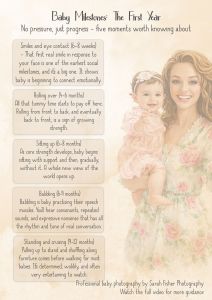
Sitting Up (Around 6-8 Months)
Sitting independently is a milestone that takes longer than most people expect. Baby usually starts by sitting with support and gradually builds the core strength to hold themselves upright without it. Once they can sit unsupported, their view of the world changes completely. They can reach for things, play in a different way, and interact more freely with whoever’s in the room.
It’s also the point at which a lot of baby photography happens to look its best, which I may be slightly biased about.
Babbling (Around 6-9 Months)
Babbling often starts to sound quite purposeful around six to nine months. You’ll hear consonants appearing, repeated syllables, and a tone and rhythm that genuinely sounds like conversation, even if the words haven’t arrived yet. Baby is practising their speech muscles and experimenting with what their voice can do. They’re also watching you closely and starting to understand that sounds get responses.
Talking back to the babbling, narrating what you’re doing, and responding as though it makes sense are all genuinely useful at this stage. Baby is listening and learning even when it doesn’t look like it.
Standing and Cruising (Around 9-12 Months)
Before most babies take independent steps, they go through a period of pulling themselves up to stand on anything available and then shuffling sideways along it, which is called cruising. It’s a determined, sometimes comical, always impressive stage. Every small trip along the sofa is practice for the bigger steps that come next.
This stage is also the beginning of what is often a fairly intense period of supervision, so enjoy the sitting stage while it lasts.
All of these milestones are things that happen in their own time, in their own order. If you have any concerns about your baby’s development at any stage, your health visitor is the right person to speak to.