
The moment baby says something that sounds like a real word is one of those milestones that tends to stop everyone in the room. But there’s quite a lot going on behind those early sounds, and some of it might surprise you.
Why “Mama” and “Dada” Come First
If your baby says “dada” before “mama,” it isn’t personal. These sounds come early because they’re physically easy to make. Simple open-and-close mouth movements, no complex tongue placement required. They’re among the first sounds a developing baby can produce, which is why they appear so reliably across so many different languages and cultures.
There’s another reason they stick around too. Every time baby makes those sounds, someone in the room lights up. That reaction is reinforcing. Baby learns very quickly that certain sounds get a response, and that makes those sounds worth repeating.
First Words Don’t Always Mean What You Think
Early vocabulary is broader than it looks. A baby who says “dog” might use that word for every animal they encounter, including cats, cows, and pigeons. A baby who says “cup” might mean any container they’re handed. This is completely normal. Early words start out covering a wide category and gradually narrow as baby makes more precise connections between sounds and specific things.
So if your baby’s first word doesn’t seem to match what you expected, it’s worth thinking about what broader category it might be representing.
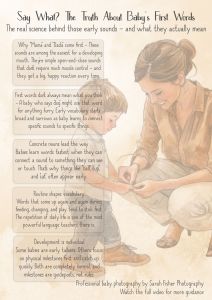
Concrete Nouns Take the Lead
Abstract words are hard to learn. You can’t point to “love” or “later.” Babies learn fastest when a sound connects directly to something they can see, touch, or hold. That’s why early vocabulary tends to be full of nouns — the names of people, objects, and animals that are part of daily life. Ball. Milk. Cat. Dog. These are things baby can look at and reach for while they’re hearing the word.
Routine Is One of the Best Language Teachers
The words that come up most often in daily life tend to be the ones that stick first. The running commentary during a nappy change, the same words at every feed, the same phrases at bedtime — all of that repetition is doing quiet, consistent work. Babies are listening to everything, and the more they hear a word in context, the faster they connect it to its meaning.
Research consistently shows that the more parents talk to their babies, the faster language develops. Even one-sided conversations matter. You don’t need to wait for baby to respond to make it count.
Development Is Individual
Some babies are chatty from early on. Others focus their energy on physical development first and then seem to find language almost all at once. Both are completely normal. The milestones around first words are guideposts rather than rules, and there’s a wide range of what’s typical. If you have any concerns about your baby’s language development, your health visitor is the right person to speak to.
What matters most in these early months is connection. Babies say the names of the people and things they love first, because language starts with relationship. Keep talking, keep responding, and those first words will come in their own time.