
At some point, most children go through a phase of wanting to look at photos of themselves as babies. They pore over them with a kind of fascinated disbelief, pointing at tiny versions of themselves and asking questions about who was there, what was happening, and what they were like. It’s more than curiosity. Children are using those images to piece together a story about themselves, and the photos you’ve taken are the material they have to work with.
What you photograph now is quietly shaping how your child understands their own life.
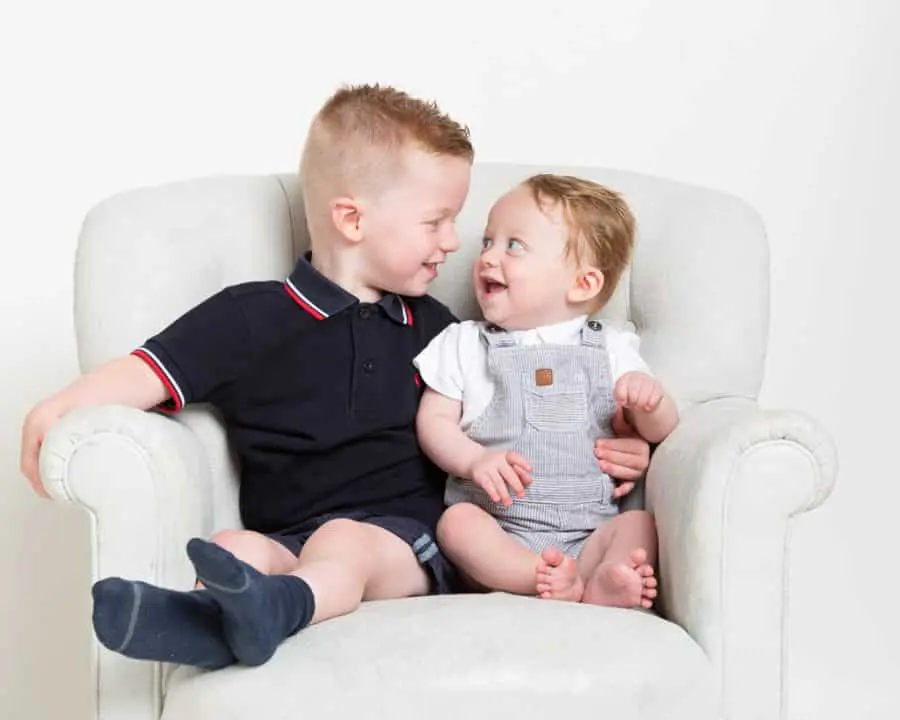
They Build a Sense of Identity
A child’s sense of who they are doesn’t arrive fully formed. It builds gradually, through experience, through relationships, and through the stories told about them. Family photos are part of that process. When a child sees themselves held by the people who love them, laughing in a familiar garden, or sitting at a table they still sit at today, they are gathering evidence of who they are and where they fit. That sense of belonging is foundational, and photographs help build it in a way that words alone often can’t.
Seeing yourself in a story makes you feel like you’re part of one.
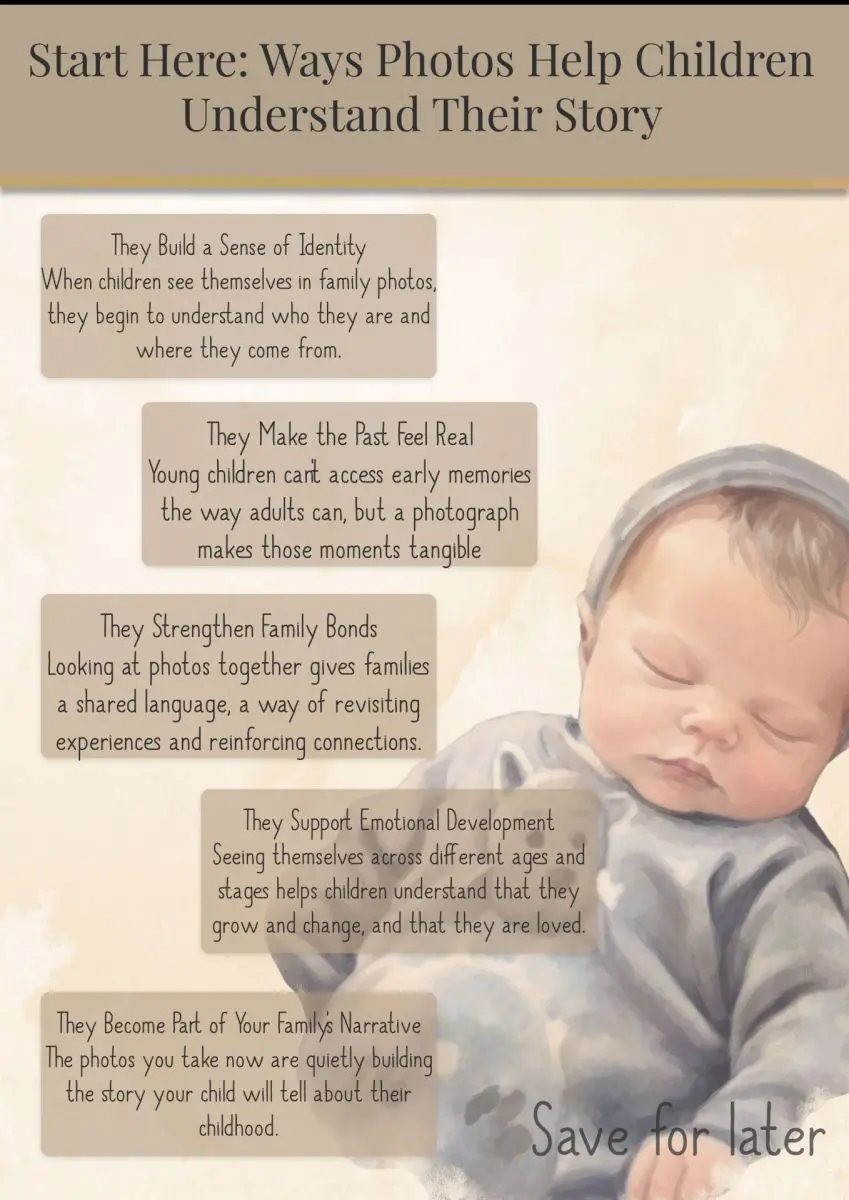
They Make the Past Feel Real
Children don’t have reliable access to their earliest memories. Most of us can’t recall anything before the age of three or four, and even those early memories are fragmentary and unreliable. A photograph changes that. It gives a child something concrete to attach to a story they’ve been told, a face, a place, a moment they can look at and say that was me. It makes the past feel real rather than imagined, and gives children a genuine connection to the earliest part of their own life.
Without photos, those years exist only in other people’s memories.
They Strengthen Family Bonds
Looking at photos together is one of those simple activities that does more than it appears to. When a family sits down with an album or scrolls through old pictures, they’re not just reminiscing. They’re reinforcing shared experience, retelling the stories that hold them together, and reminding each other of who they are as a unit. For children, being part of that process, hearing the stories, asking questions, seeing themselves reflected in the people around them, is deeply reassuring.
It’s one of the quieter ways families stay connected to each other.

They Support Emotional Development
Seeing themselves across different ages and stages helps children understand something important: that they change, that they grow, and that they are loved throughout all of it. A photo of a baby who is now a five-year-old gives that child a way to think about their own development. They can see that they were once small and are now bigger. They can understand that the people in the photo have always been there. That continuity is emotionally grounding in a way that’s easy to underestimate.
Children who feel securely held in their family’s story tend to find it easier to face the world.
They Become Part of Your Family’s Narrative
Every family has a story, and photographs are a significant part of how that story gets told and retold. The images you take now, the ordinary ones as much as the milestone ones, are quietly becoming the material your child will use to understand their own childhood. Long after the lived experience has faded, the photos remain. They become the version of events your child carries forward, the visual memory of a time they were too young to remember for themselves.
What you photograph now matters more than it might seem in the moment.