
If you have ever had a toddler point urgently at something and get completely baffled that you have no idea what they mean, you have already had a front-row seat to Theory of Mind in action. Or rather, the lack of it. It is one of the most interesting things that happens in early childhood, and once you know what to look for, you start seeing it everywhere.

What is Theory of Mind?
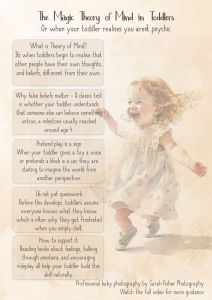
Theory of Mind is the understanding that other people have their own thoughts, feelings, beliefs, and knowledge, and that these can be different from your own. It sounds simple, but for a toddler it is genuinely a new idea. Before this develops, your toddler assumes you see, know, and feel exactly what they do. You are not a separate person with your own perspective. You are just an extension of theirs.
This shift typically starts to emerge somewhere between ages two and four, and it changes a lot about how your toddler relates to the world around them.
Why false beliefs matter
One of the classic ways researchers test for Theory of Mind is what’s called the false belief task. A child sees a toy being moved to a new location without another person knowing. Can they understand that the other person will still think the toy is in its original place?
Before Theory of Mind develops, most toddlers say no. They assume the other person knows what they know. Once it develops, they begin to grasp that someone else’s knowledge can be different from their own. It is a small shift with a big impact, and it usually clicks around age four.
Pretend play is a sign
If your toddler picks up a banana and pretends it is a phone, or gives their teddy a name and a whole personality, that is not just silliness. It is early evidence of perspective-taking. They are imagining what it would be like to be something or someone else, which is exactly the kind of thinking that Theory of Mind is built on.
Pretend play tends to grow more elaborate as this understanding develops, and it is one of the most natural ways toddlers practise it.
It’s not just guesswork
A lot of classic toddler behaviour makes more sense once you understand Theory of Mind. The frustration when you don’t immediately understand what they want. The assumption that you already know what happened at nursery without being told. The absolute certainty that you must have seen the thing they saw this morning, even though you were nowhere near.
These are not unreasonable from a toddler’s point of view. They genuinely haven’t yet learned that your knowledge and their knowledge are two different things.
How to support it
You don’t need to do anything complicated. Reading books where characters have different thoughts and feelings, talking about emotions openly, and encouraging roleplay all help. Gentle corrections work well too. Saying something like “you thought Daddy was in the kitchen, but he was actually in the garden” gives your toddler a small, concrete example of how two people can have different information about the same thing.
It develops in its own time, but those small everyday conversations matter more than you might think.