
Teething is one of those things that every parent hears about before it happens, and then finds slightly more confusing than expected once it does. When does it start? Why is your baby chewing everything? Is that temperature actually from teething? Here’s what’s actually going on.

Your baby is born with all 20 teeth already
Not visible, obviously. But tucked inside the gums, all 20 milk teeth are already there at birth, fully formed and waiting. They start developing in the womb around six weeks of pregnancy, which is quite something to think about when you’re looking at a newborn.
The first tooth usually arrives between 6 and 10 months
There’s a fairly wide window here, and all of it is normal. Some babies get their first tooth as early as four months; others don’t see one until after their first birthday. The lower front teeth tend to come first, followed by the upper front teeth, and then the rest gradually follow over the next couple of years.
The signs often start long before you see anything
This is the part that catches a lot of parents out. Flushed cheeks, drooling, ear pulling, and a sudden need to chew absolutely everything can all start weeks or even months before a tooth actually breaks through. So if your baby seems off and you can’t see anything, teething could still be the reason.
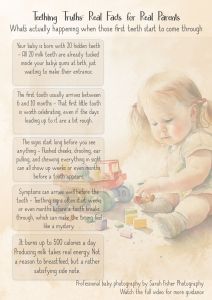
Symptoms can arrive well before the tooth
Teething discomfort comes from the tooth moving through the gum, which starts happening long before it becomes visible. This is why the timeline can feel so unpredictable. Your baby might have a rough few days, seem fine for a week, and then have another difficult patch before anything appears.
Cold and gentle pressure both help
A chilled teething toy is one of the most effective options. A gentle gum massage with a clean finger can also help, as can a cold damp cloth from the fridge. The cold helps to numb the area slightly, and the pressure gives the gums something to push against. Avoid anything frozen solid, as that can cause discomfort of a different kind.
The full set is usually in by age three
By around their third birthday, most toddlers have all 20 milk teeth. It feels like a long process when you’re in the middle of it, but it does end. Sleep returns. The chewing slows down. And you’ll have a full set of little teeth to photograph, which is where I come in.