One of the things I love about photographing newborns is how much is already going on with them. They arrive looking small and sleepy, but underneath all of that there’s a whole set of built-in instincts working away. These reflexes are the body’s way of helping a newborn survive and adapt in those first weeks of life, and some of them are genuinely fascinating to watch.
Here are five of the most well-known newborn reflexes and what they’re actually for.

The Moro Reflex (Startle Reflex)
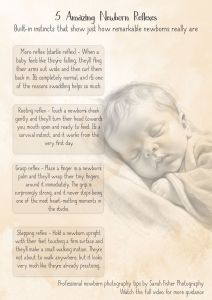
This is one parents notice almost immediately. If a newborn feels like they’re suddenly falling, or hears a loud noise, they’ll throw their arms out wide and then curl them back in towards their body. It can look quite dramatic, and it often wakes them up right as they’re drifting off, which is understandably frustrating at 3am.
It’s a completely normal response, and it’s actually one of the reasons swaddling is so effective. Keeping a baby’s arms contained reduces the chances of the startle reflex jolting them awake. The Moro reflex typically fades somewhere between two and four months.
The Rooting Reflex
Touch a newborn’s cheek gently and they’ll turn their head in that direction, mouth open, ready to feed. It’s a survival reflex that helps baby find milk, and it works right from birth. It’s also why feeding often goes more smoothly when you stroke the cheek nearest to you rather than trying to guide the baby’s head directly.
The rooting reflex gradually disappears around three to four months, as feeding becomes a more conscious, learned behaviour.
The Grasp Reflex
Place a finger in a newborn’s palm and they’ll close their hand around it. The grip is surprisingly firm for something so small, and it’s one of those moments that tends to stop people in their tracks. In the studio I see it happen with parents all the time, and it gets them every single time.
The grasp reflex is present from birth and starts to fade around five to six months, as baby gains more voluntary control over their hands.
The Stepping Reflex
Hold a newborn upright so their feet are resting on a firm surface and they’ll make a small, deliberate walking motion. They’re not about to take any actual steps, but the movement is unmistakable. It looks for all the world like they’re already practising.
This reflex disappears after about two months and then reappears later as your baby develops the strength and coordination to actually walk. It’s one of those reflexes that feels a little magical when you see it.
The Tonic Neck Reflex (Fencing Reflex)
This one is less well known but very distinctive once you know what to look for. When a newborn turns their head to one side, the arm on that side will straighten out while the opposite arm bends at the elbow, like a tiny fencer mid-pose. It’s involuntary and completely harmless, and it usually disappears by around five or six months.
All of these reflexes are your newborn’s body doing exactly what it’s supposed to do. They’re signs of a healthy nervous system, and most of them fade naturally as your baby grows and develops more voluntary control. If you ever have concerns about any of your baby’s reflexes, your health visitor or GP is the right person to speak to.